Crypto prop firms offer traders an opportunity to trade larger account sizes without committing substantial personal capital. Depending on the firm's program, available instruments may include cryptocurrencies, perpetual futures, spot markets or other financial products such as forex, indices, stocks and commodities. Typically, traders pay an evaluation fee, meet specified profit targets and risk limits, and qualify for a funded account or performance-based rewards.
But are crypto prop firms legit?
Some operate transparent businesses with clearly documented rules and established payout processes. Others may have unclear ownership, restrictive trading conditions or questionable payout practices. The distinction matters because buying an evaluation does not guarantee access to real trading capital or future income. Before paying for a challenge, traders should understand how the firm operates, what its account represents and what conditions govern withdrawals.
Here is what to check before buying an evaluation from a crypto prop firm.
Are Crypto Prop Firms Legit?
Crypto prop firms can be legitimate businesses, but a professional website, attractive profit split or positive testimonials do not establish legitimacy.
Consider four separate questions:
- Business legitimacy: Does the firm disclose its legal entity, ownership and contact information?
- Business model: Does it explain whether traders use simulated accounts or trade with real capital?
- Contractual transparency: Are evaluation rules, drawdown limits and payout conditions clearly documented?
- Regulatory status: Does the firm's actual activity require authorization in the jurisdictions where it operates?
A company may be a genuine business without being a regulated broker or investment manager. Equally, the absence of a particular financial licence does not automatically establish fraud. Regulatory requirements depend on the firm's activities, legal structure and operating jurisdictions.
The important thing is to assess the business model and contractual obligations rather than rely on marketing claims.
How Do Crypto Prop Firms Work?
Most crypto prop firms use an evaluation-based model. Although these firms are commonly associated with cryptocurrency trading, their available instruments can vary. Some focus on spot cryptocurrencies, while others offer crypto derivatives such as perpetual futures. Certain firms also extend their simulated trading programmes to traditional markets, including forex, stock indices, equities and commodities.
Therefore, traders should check which instruments are actually available rather than assume that every crypto prop firm follows the same trading model.
- Purchase an evaluation: A trader selects an account size and challenge model, such as a one-step or two-step evaluation, and pays the required fee.
- Meet the trading objectives: The trader must achieve a specified profit target without violating rules covering maximum drawdown, daily losses, consistency or trading strategies.
- Qualify for a funded account: After passing, the trader may receive access to another account, subject to the firm's conditions.
- Earn performance-based rewards: Eligible traders receive a share of profits or performance-based compensation, depending on the programme's payout policy.
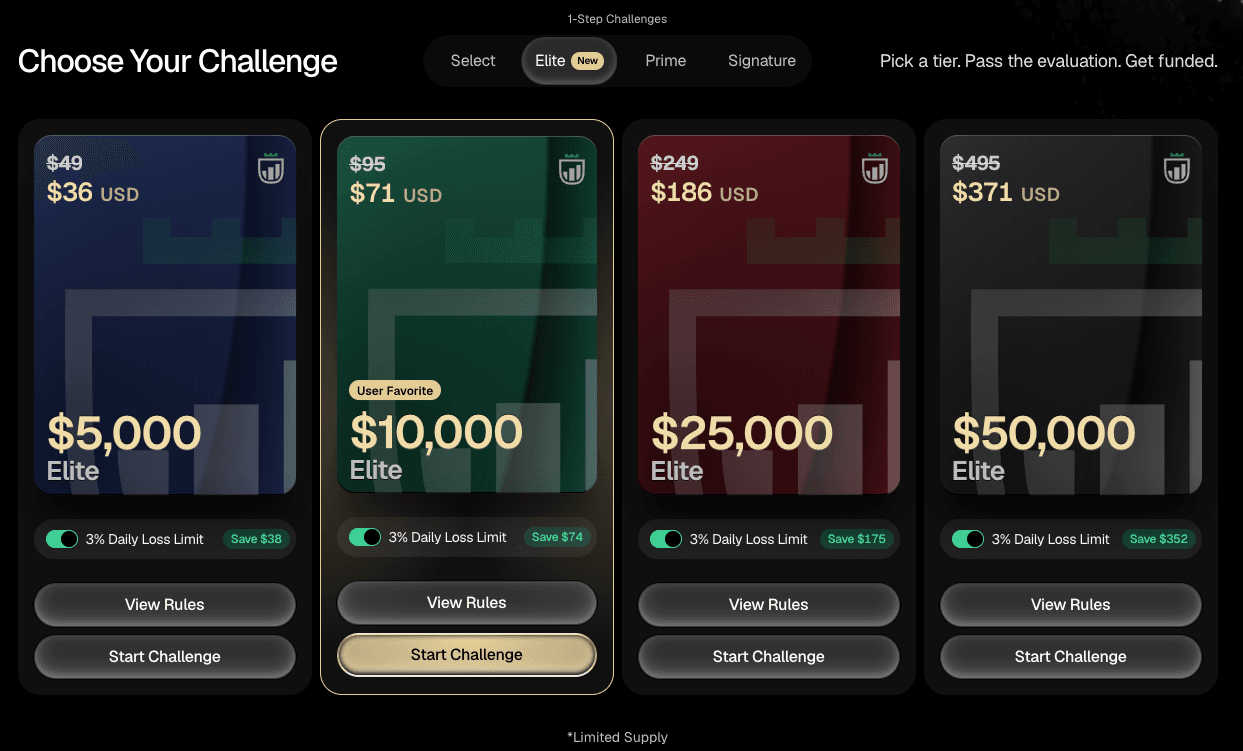
Source: MyFundedPerps
Does a funded account use real money?
Not necessarily. Some firms use simulated trading environments for both evaluations and subsequent funded stages. Others may allocate capital or execute selected trading activity in live markets. Some operate hybrid models.
In a simulated model, traders place orders in an environment that tracks market prices, but their trades may not be executed on a live exchange. The firm may pay eligible traders based on their simulated performance and contractual terms.
Therefore, a $100,000 advertised account does not necessarily mean $100,000 has been deposited into an account in your name. Ask what the account size represents and how trading performance translates into compensation.
10 Things to Check Before Buying a Crypto Prop Firm Evaluation
1. Company Registration and Ownership
Start by identifying the business operating the website. Look for its full legal name, registered jurisdiction, business address and contact details.
Where possible, verify the registration through the relevant corporate registry. Check whether the company named in its terms and conditions matches the entity presented on its website.
Company registration alone does not establish financial soundness or reliable payouts. However, a firm that provides little verifiable information about its ownership or operating entity deserves additional scrutiny.
2. Regulatory Status
Do not assume that every crypto prop firm operates under the same regulatory framework.
A firm offering simulated trading and performance-based rewards may have a different regulatory position from one accepting customer deposits, executing trades, providing brokerage services or managing investments.
Check any claims of regulatory authorization directly with the relevant regulator. Also distinguish between company registration and financial authorization: incorporating a company does not automatically permit it to provide regulated financial services.
3. Evaluation Fees and Hidden Costs
The advertised evaluation fee may not represent the total cost of participating. Depending on the programme, additional charges can include:
- Account resets or retries.
- Activation
- Monthly subscriptions.
- Platform or market-data fees.
- Withdrawal or processing charges.
- Currency conversion costs.
Check whether the evaluation fee is refundable or credited towards a funded account. Review cancellation and refund conditions as well.
Compare the total cost across programmes rather than choosing an evaluation solely because it advertises a large account size.
4. Drawdown and Risk Rules
Drawdown rules determine how much a trader can lose before violating the firm's conditions. Understand the calculation method, not just the advertised percentage.
Common models include:
- Static drawdown: The loss threshold remains fixed relative to the starting balance.
- Trailing drawdown: The threshold moves upward as the account reaches new balance or equity highs, depending on the firm's methodology.
- End-of-day drawdown: The loss threshold is recalculated at a specified daily closing point, often using the account's end-of-day balance or equity. The threshold generally remains fixed during the following trading session, depending on the firm's rules.
Also establish whether losses are measured using balance or equity. Equity-based calculations typically account for unrealized profits and losses on open positions, while balance-based calculations generally use the account balance after closed trades. Check the firm's methodology to understand how open positions, commissions and unrealized profits affect the loss threshold.
Check the daily loss limit, overall maximum loss, treatment of commissions and whether unrealized profits affect the drawdown threshold.
Example: A challenge starts with a $10,000 balance and a 10% static maximum drawdown. The account's loss threshold remains fixed at $9,000, regardless of subsequent profits. Under a trailing drawdown model, the threshold may rise as the account reaches new highs, depending on whether the firm tracks balance or equity.
5. Profit Splits and Payout Conditions
A headline profit split of 80% or 90% does not tell you how easily you can withdraw earnings.
Review the complete payout policy, including:
- The trader's share of eligible profits.
- Minimum withdrawal amounts.
- First payout waiting periods.
- Withdrawal frequency.
- Minimum trading-day requirements.
- Consistency rules and payout caps.
- Conditions that can result in rejected withdrawals.
Some firms restrict how much of a trader's total profit can come from a single trading day. Others impose additional performance requirements before allowing withdrawals.
Passing an evaluation and qualifying for a payout are two different milestones. Understand the requirements for both.
6. Simulated Versus Live Trading
Ask the firm what happens after you pass the evaluation.
Find out whether the evaluation and subsequent account use simulated trading, whether any trades are executed on live exchanges and whether the firm copies selected trades into live markets.
A simulated account is not automatically evidence of an illegitimate business. However, traders should understand that simulated performance may not translate directly into live-market execution or profits.
The distinction also affects how you interpret the advertised account size, risk and performance-based rewards.For example, MyFundedFutures Studio uses simulated trading during its evaluation and Sim Funded stages, with eligible traders able to progress to a separate live account after meeting the program's requirements. This provides an example of how a prop firm's simulated trading model can include a defined pathway towards live trading.
7. Spreads, Slippage and Execution Quality
Execution conditions can materially affect trading performance, particularly for scalpers and short-term traders.
Slippage occurs when an order executes at a different price from the expected price. It can happen during rapid market movements, periods of low liquidity or when large orders interact with limited market depth.
Check the firm's spreads, commissions, order execution methods and treatment of stop-loss orders. If disclosed, examine the exchanges or liquidity providers supplying prices.
For firms offering perpetual futures, traders should also understand how funding rates affect trading costs. Perpetual futures are derivative contracts without a fixed expiration date, and periodic funding payments between long and short positions help keep their prices aligned with the underlying market. These costs can affect overall trading performance.
If the firm uses simulated execution, ask how prices and fills are generated. A strategy that works on one exchange may produce different results under another firm's spreads, fees and execution conditions.
8. Trading Platform and Transparency
Check which platforms the firm supports and whether you can access detailed trade histories.
You should be able to review order fills, fees, account balances and equity changes. Also examine the available instruments, order types, platform reliability and customer support.
A familiar trading interface does not guarantee good execution. The platform is only one part of the firm's trading infrastructure.
9. Prohibited Strategies and Account Restrictions
A profitable strategy may still violate a firm's rules. Restrictions commonly cover:
- High-frequency trading and latency arbitrage
- Copy trading between accounts
- Automated bots
- Hedging across multiple accounts
- News-event trading
- Martingale or grid strategies ((increasing size after losses, or stacking trades at fixed price intervals against the trend)
- Account sharing and VPN usage
- Trading from restricted jurisdictions or extended inactivity
These restrictions should be clearly disclosed. If you use automated strategies, trade around major announcements or hold positions over weekends, verify the relevant rules before purchasing.
10. Customer Support and Payout History
Research independent feedback about evaluation experiences, account closures, customer support and withdrawals. Review platforms and communities such as Reddit can help identify recurring concerns, but individual complaints and positive testimonials are not conclusive evidence.
Look for patterns: Are payout delays repeatedly reported? Does the firm explain rejected withdrawals? Are rule changes communicated clearly? Are complaints resolved?
Contact customer support before purchasing and ask specific questions about drawdown calculations, account models and payout eligibility. Vague or contradictory answers are reasons to pause.
How to Verify a Crypto Prop Firm Before Paying
Use this checklist before purchasing an evaluation:
- Identify the legal entity and verify its registration.
- Independently check any regulatory claims.
- Read the complete evaluation and payout terms.
- Calculate the total cost, including resets and activation fees.
- Work through an example of the firm's drawdown calculation.
- Confirm whether trading is simulated, live or hybrid.
- Research independent feedback and recurring complaints.
- Ask customer support specific questions and retain written responses.
If you decide to proceed, choose an evaluation whose fee you can afford to lose. Do not borrow money or use funds needed for essential expenses.
Are Crypto Prop Firm Evaluations Worth It?
Evaluations may appeal to traders who already have a tested strategy but want to avoid committing substantial personal trading capital.
However, they are not suitable for everyone.
| Potential Advantages | Potential Disadvantages |
|---|---|
Access to larger account size | Evaluation and reset fees can accumulate |
Defined trading objectives and risk limits | Strict rules can result in account termination |
Opportunity to earn performance-based rewards | Passing does not guarantee payouts |
An evaluation may be worth considering if you understand crypto market structure, leverage, position sizing, liquidation risk and the firm's rules.
It may be a poor choice if you are still learning to trade, depend on borrowed money or expect a prop firm to provide a shortcut to consistent profits.
Final Verdict: Are Crypto Prop Firms Legit?
Some crypto prop firms operate legitimate evaluation and performance-reward programmes, but the industry should not be treated as uniformly reliable or regulated.
Before buying an evaluation, look beyond the advertised account size, entry fee and profit split. Verify the company behind the programme, understand its regulatory position, examine its trading model and read the complete drawdown and payout rules.
Execution quality matters too. Spreads, commissions, slippage and funding costs can affect whether your strategy remains viable under the firm's conditions.
Ultimately, the question is not simply whether a crypto prop firm is legit. It is whether its business model is transparent, its contractual terms are clear and its rules are compatible with the way you trade.
An evaluation fee is a business expense with a risk of loss, not an investment that guarantees access to capital or future income.
¹This material is provided for educational purposes only and should not be relied upon as trading, investment, tax, or legal advice. All participation in MyFundedFutures (MFFU) programs is conducted in a simulated environment only; no actual futures trading takes place. Performance in simulated accounts is not indicative of future results, and there is no guarantee of profits or success. Fewer than 1% of participants progress to a live-capital stage with an affiliated proprietary trading firm. Participation is at all times subject to the Simulated Trader Agreement and program rules.
Frequently Asked Questions
Rate this article
Related Posts
Read our most popular posts
MyFundedFutures' Studio vs. Vest Markets: Rules, Fees and Payouts Compared
Compare MyFundedFutures Studio vs. Vest Markets on fees, trading rules, drawdown limits, profit splits, and payouts to understand which program suits your trading needs.

Tokenized Stock Perps Explained: Trading Tesla, Apple and Nvidia 24/7
Learn how tokenized stock perpetuals work, how to trade Tesla, Apple and Nvidia price movements, and what to know about leverage, funding fees and risk.
Perpetual Futures vs Futures: What's the Difference?
Learn the difference between perpetual futures and traditional futures, including expiration, funding rates, rollover costs, margin, settlement and trading risks.